Nearly every level in this genre belongs to one of four families. Recognising which family you are in takes about two seconds and improves your play more than any booster, because each one rewards a completely different reading of the same grid.
Clear: remove the layer underneath
The board sits on top of something — jelly, icing, frosting — and matches erase it. The useful move is the one over uncleared ground, which frequently is not the biggest available match. Players who lose these levels usually lose them by making excellent matches in the middle of a board they have already finished clearing.
Read the underlay first, the sweets second. If the goal is a corner, everything else is decoration.
Collect: bring the right pieces
The level names a quota: twelve red, ten wrapped, six of something rarer. Here the board becomes a search problem. The trap is momentum — you find a satisfying chain, take it, and it produces none of the colour you actually need. Collect levels are where players hit the most walls, because the random refill can simply refuse to co-operate.
The counter-play is patience: pass over the flashy match and take the small one in the right colour.
Drop: walk something to the bottom
An object sits high on the board and must reach the floor. This is the only family where the space below a piece matters more than the piece itself, and the only one where clearing the wrong row actively hurts you by refilling the column you just emptied.
Work upward from the bottom row. It feels backwards and it is correct.
Score: squeeze the board
No objective except a number before the moves run out. These are the most forgiving to fail and the most rewarding to play well, because chains multiply and a single well-set cascade can be worth twenty ordinary matches. It is also the family where boosters are least necessary.
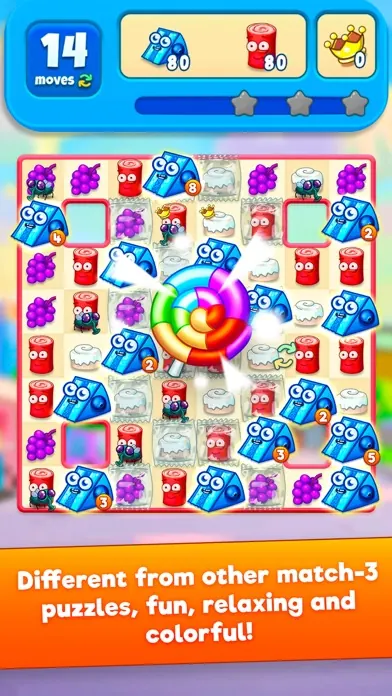
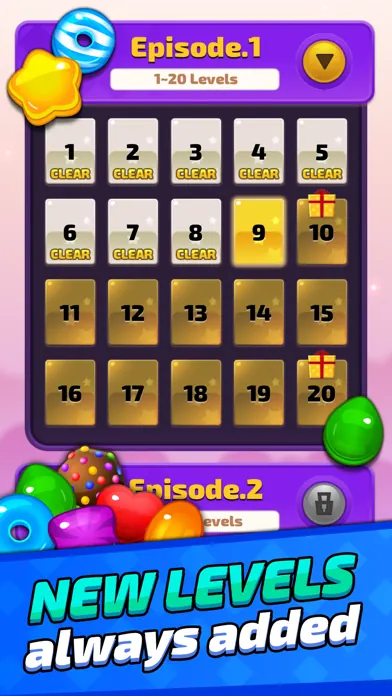
Screenshots from the official Australian store listings. All rights remain with the publishers.
Why games mix them
A game that only ever asked for one goal type would be exhausted in fifty levels. Rotating the four keeps the same grid feeling different, which is why the level map in most of these titles reads as a sequence of small genre shifts rather than a difficulty ramp. When a game feels like it has stopped progressing, it is usually because it has stopped rotating.
What this means when choosing a game
Ask which family the game leans on. A collection-heavy title will stall you on random refills and push boosters hardest. A score-heavy title will let you play indefinitely without spending. A drop-heavy title demands the most spatial thinking and is the worst choice for playing half-asleep.
Of the four titles on this site, one leans on clearing, one on collecting, one on obstacles and one on score. That was not an accident when choosing them.